
The dynamics of the world can be understood through the balance of power. This is the tragic dimension of history I mentioned yesterday. Within this framework, one can find many elements: ideology, military power, or even the ability to become indispensable through currency and financial markets.
This power struggle between regions is also built on economic data. This dimension underpins the capacity to innovate, to be competitive, and ultimately to continue to influence world affairs.
In the ongoing reshaping of the world, these economic power dynamics will play a key role. To understand the implications, I compared the three major regions of the world in terms of production, exports, and competitiveness. Each region’s curve is expressed relative to the overall curve excluding the region being analyzed. This provides a more nuanced perspective. The data is presented with a base of 100 in 2021 to better capture the post-pandemic dynamics. The latest available figure is from October 2025, published by CPB in the Netherlands.
Industrial production and exports send the same type of signal
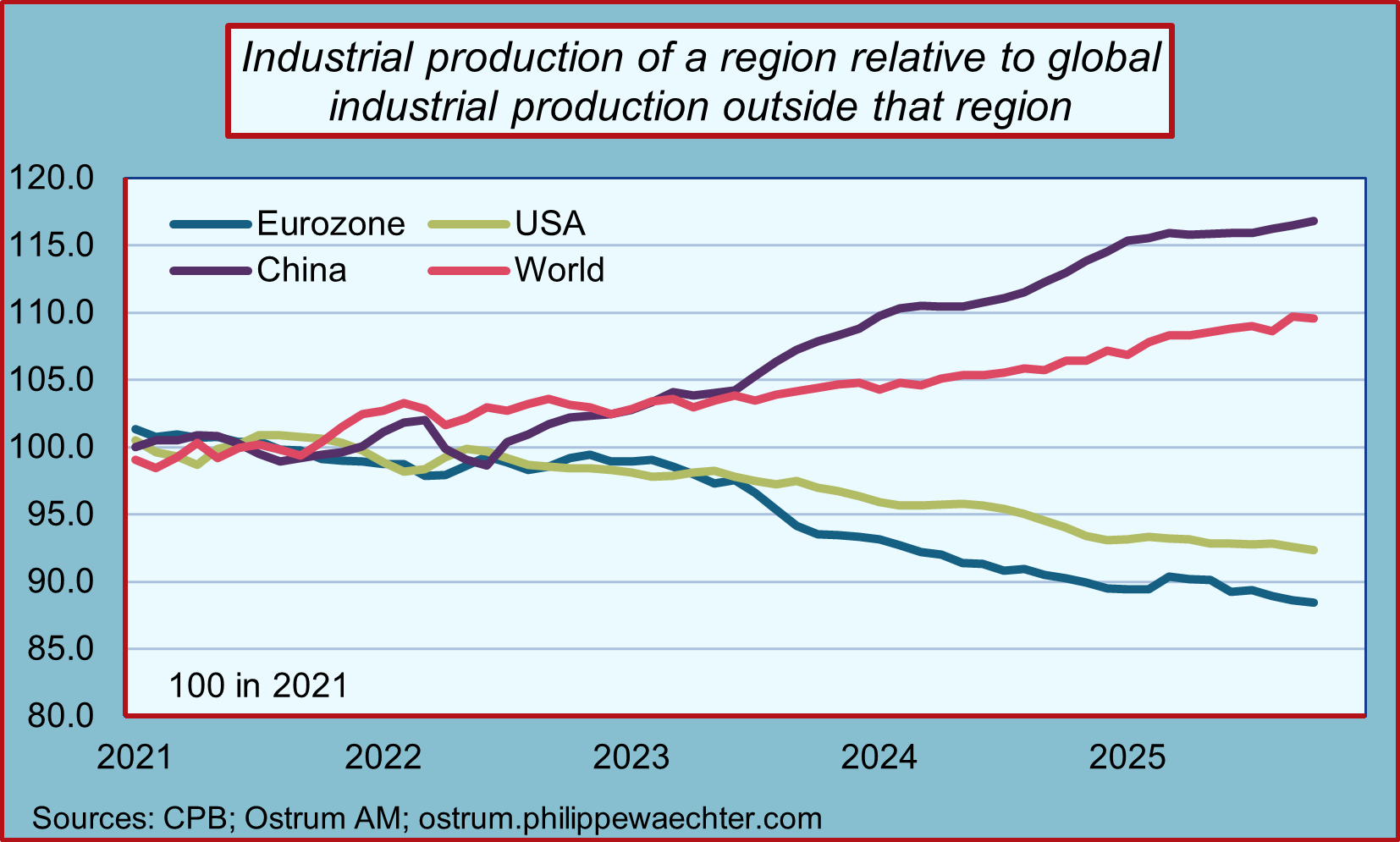
China dominates the activity. Its production and exports are growing much faster than those of the world.
The United States is underperforming compared to the global economy, particularly in industrial production.
The Eurozone is significantly underperforming in industrial production and exports
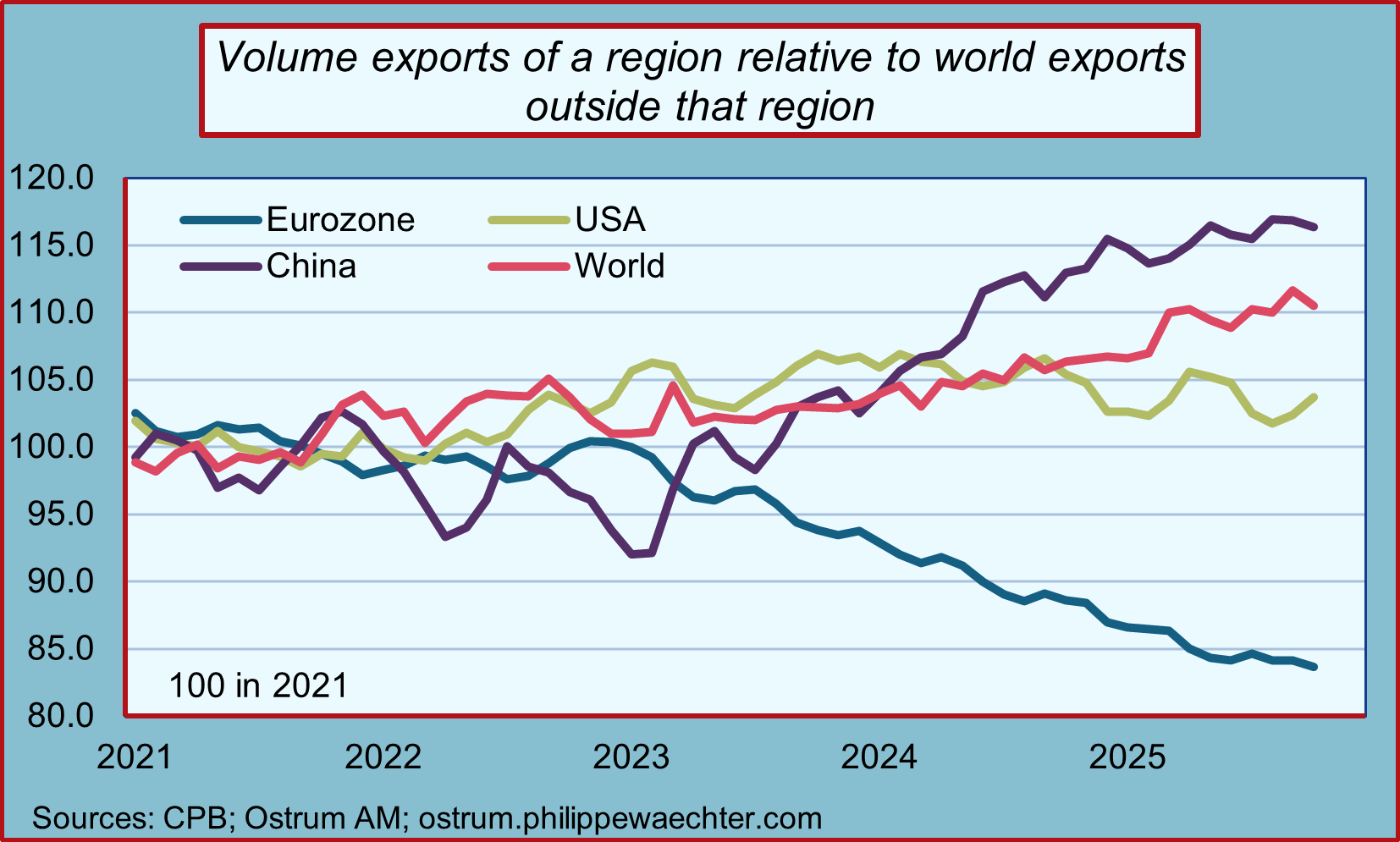
In just a few short years, the differences are considerable. For the Eurozone, the relative decline in production and especially exports suggests a loss of price competitiveness, capacity to innovate, and quality of the zone’s products.
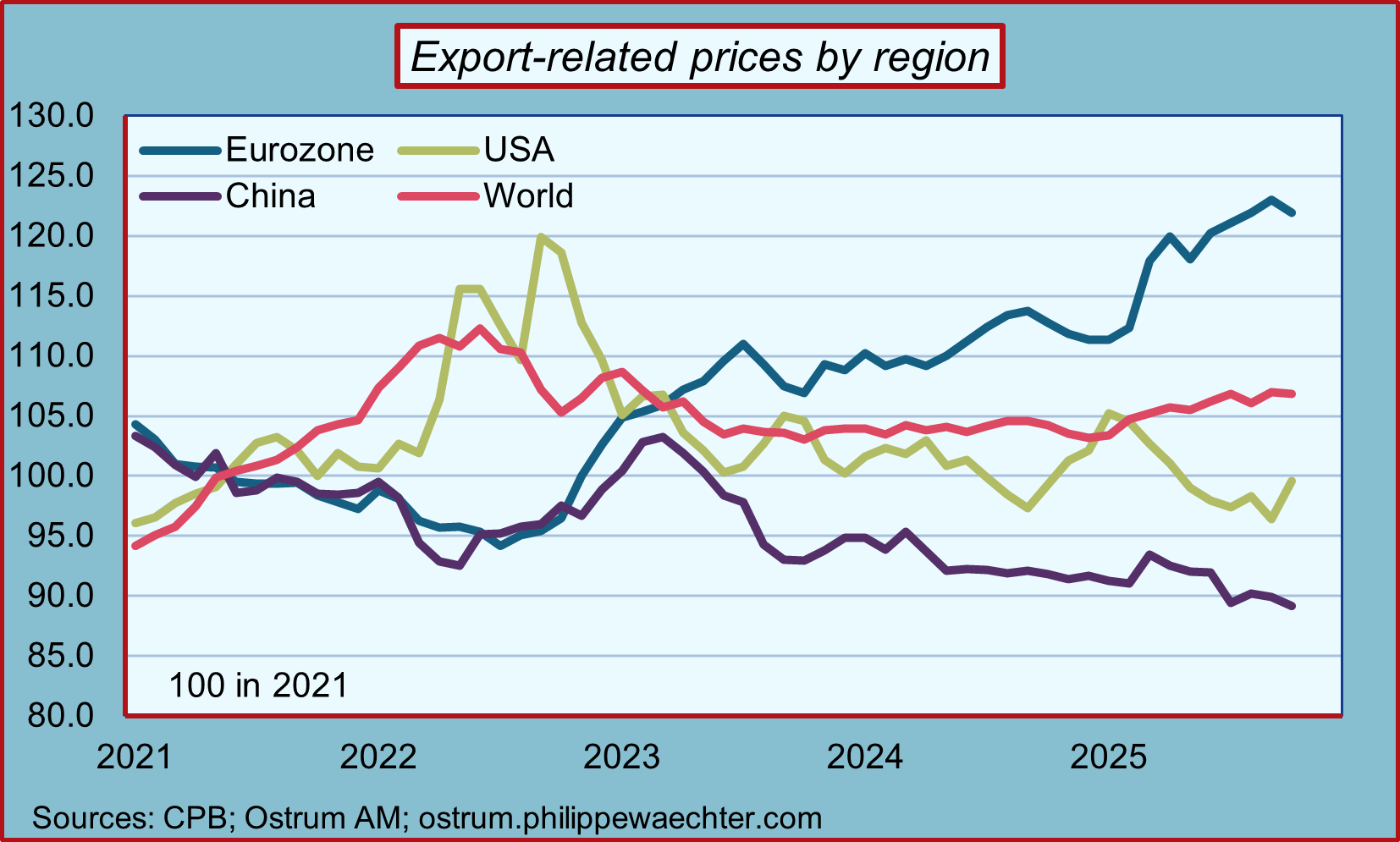
The export price index shows strong price competitiveness in China, while prices in the Eurozone have become too high. The situation is neutral in the USA
The challenge for Europeans is threefold.
- How to avoid being directly challenged in your market by cheap and innovative Chinese products
- How can one have influence on the world and world affairs when one’s economic weight is dwindling?
- We really need to shift the paradigm. The Draghi report, reindustrialization, and acknowledging the current state of the world must be more than just empty words.
Philippe Waechter is Ostrum AM chief economist in Paris