

Is Europe merely a consumer market, with production that is of no interest to the rest of the world?
That is one conclusion we might draw from the trends in international trade volumes. Global exports rose by nearly 7% in the first nine months of 2026, those of the advanced Asian economies (Taiwan, South Korea, Hong Kong and Singapore) by 24%, China’s by 14.5%, and US exports by 6.3%. But euro area exports contracted by 1.2%.
The chart shows the change in global exports excluding the euro area, alongside euro area exports. The former are up 30% since 2021, while the latter are down 3.5%.
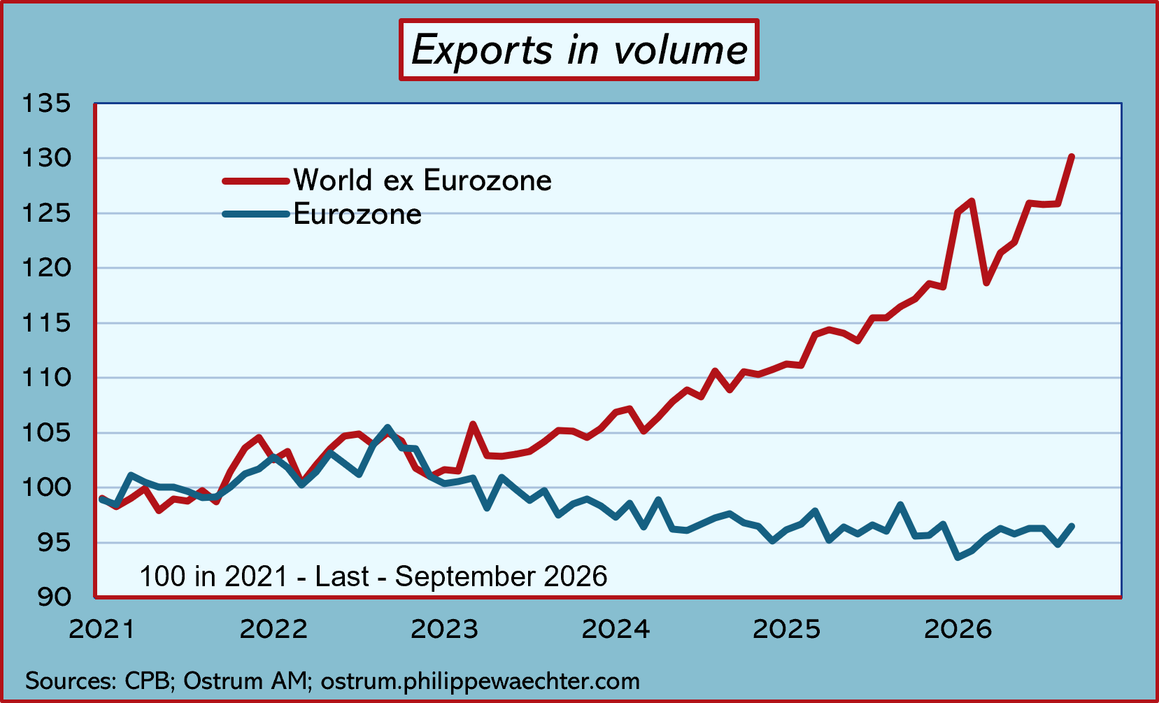
International trade is accelerating and driving global industrial activity higher. Yet the euro area is attracting little interest, and its products are not part of this trend. They no longer excite buyers around the world. Of course, some companies have established operations where activity is buoyant and sell locally. But the model of producing in Europe and then exporting those goods is no longer working.
This reflects poor industrial specialisation. Europe makes products that the rest of the world does not want. This may partly be a pricing issue: export prices are indeed higher than elsewhere. It may also be that Europe is no longer competitive in many areas of traditional industry. We can see this in the competition from Chinese electric vehicles. Competition is all the fiercer because growth in Europe is weak and, as a result, consumer demand is subdued. This does not mean that aircraft manufacturing is not working, but it is an isolated success.
Trade is mainly taking place in Asia, particularly in AI-related products, where Europe has little presence. Europe has been unable to create champions capable of operating at a scale suited to a global market. Korean, Chinese and US companies, by contrast, have a home market that is global almost by default.
The European single market is too fragmented to generate economies of scale. Europe is slipping into the second division, while still believing it can lead the first. That is its real predicament.