


Ostrum
  • News & Chronicles
  • France
  • Euro Area
  • United States
  • International
  • Politics & Society
  • Monetary Policy
  • Media
  • Decoding
  • About Philippe Waechter
Philippe Waechter's blog
  • Insights
  • About us
  • Expertise
  • Our people
  • Media

Philippe Waechter's blog
My french blog
  • News & Chronicles
  • France
  • Euro Area
  • United States
  • International
  • Politics & Society
  • Monetary Policy
  • Media
  • Decoding
  • About Philippe Waechter
  • News & Chronicles
  • Climate
  • France
  • Euro Area
  • United States
  • International
  • Politics & Society
  • Monetary Policy
  • Media
  • Decoding
Philippe Waechter's blog
Prévôté
Previous
  • 2 min

Electricity is becoming decarbonized, but the planet is not.

  • 6 July 2026
  • Philippe Waechter
Total
0
Shares
0
0
0

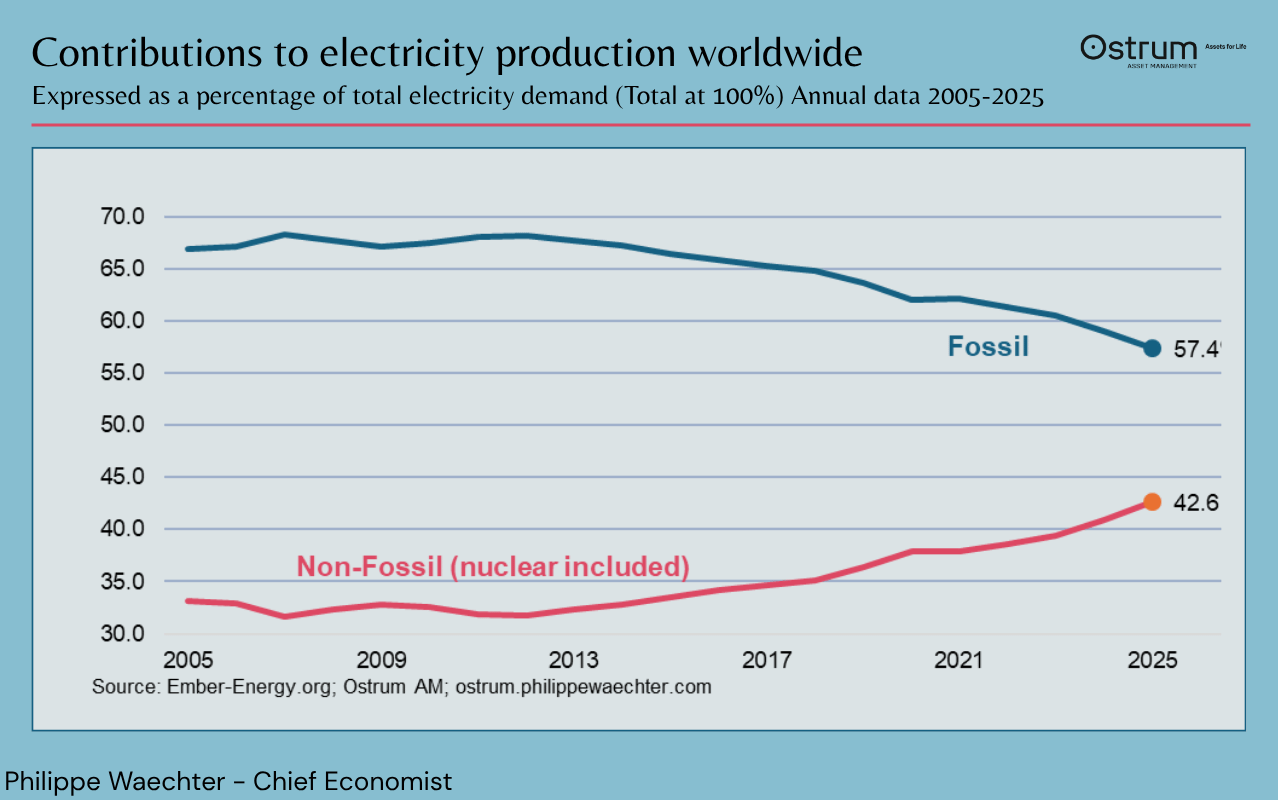
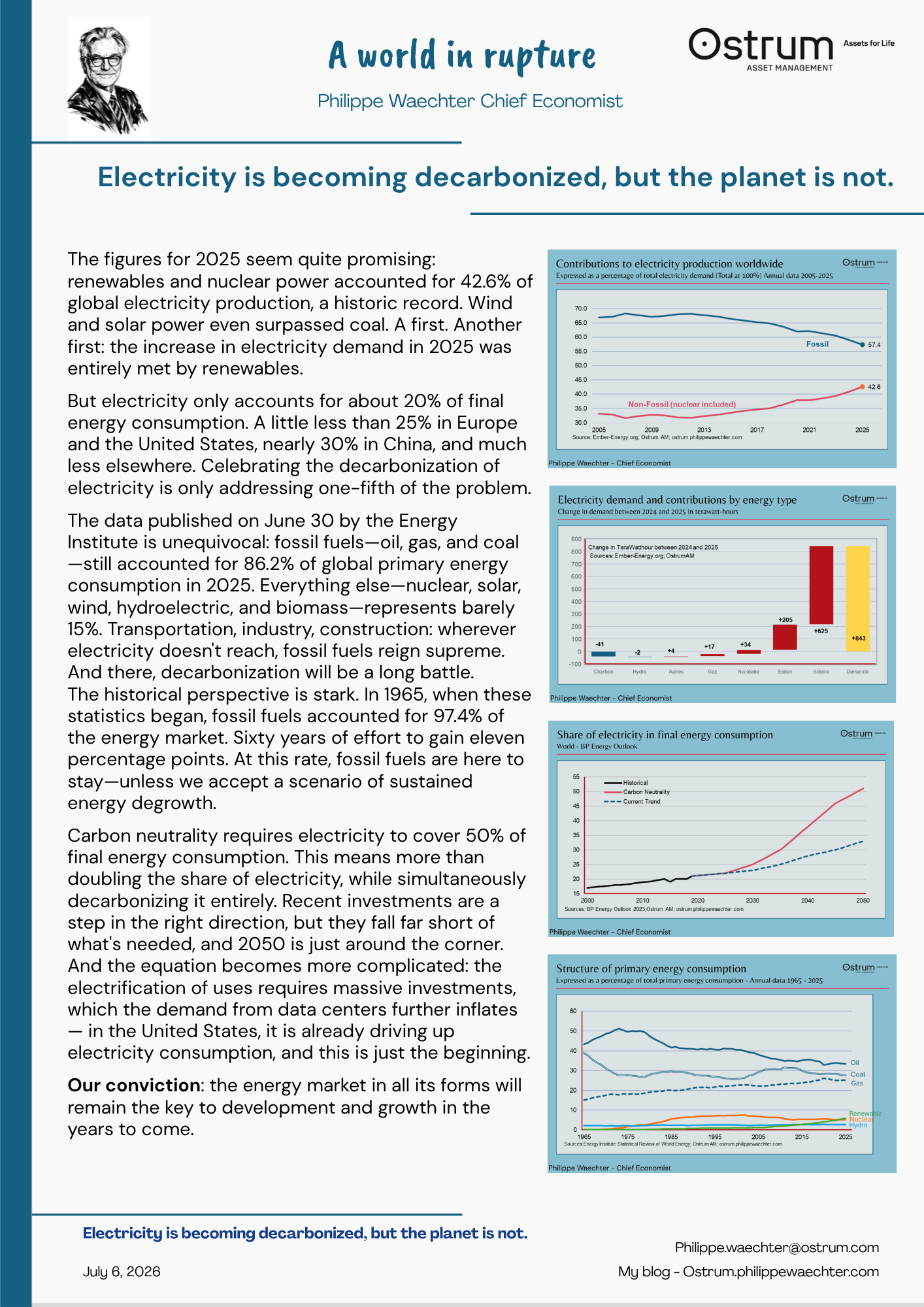
The figures for 2025 seem quite promising: renewables and nuclear power accounted for 42.6% of global electricity production, a historic record. Wind and solar power even surpassed coal. A first.
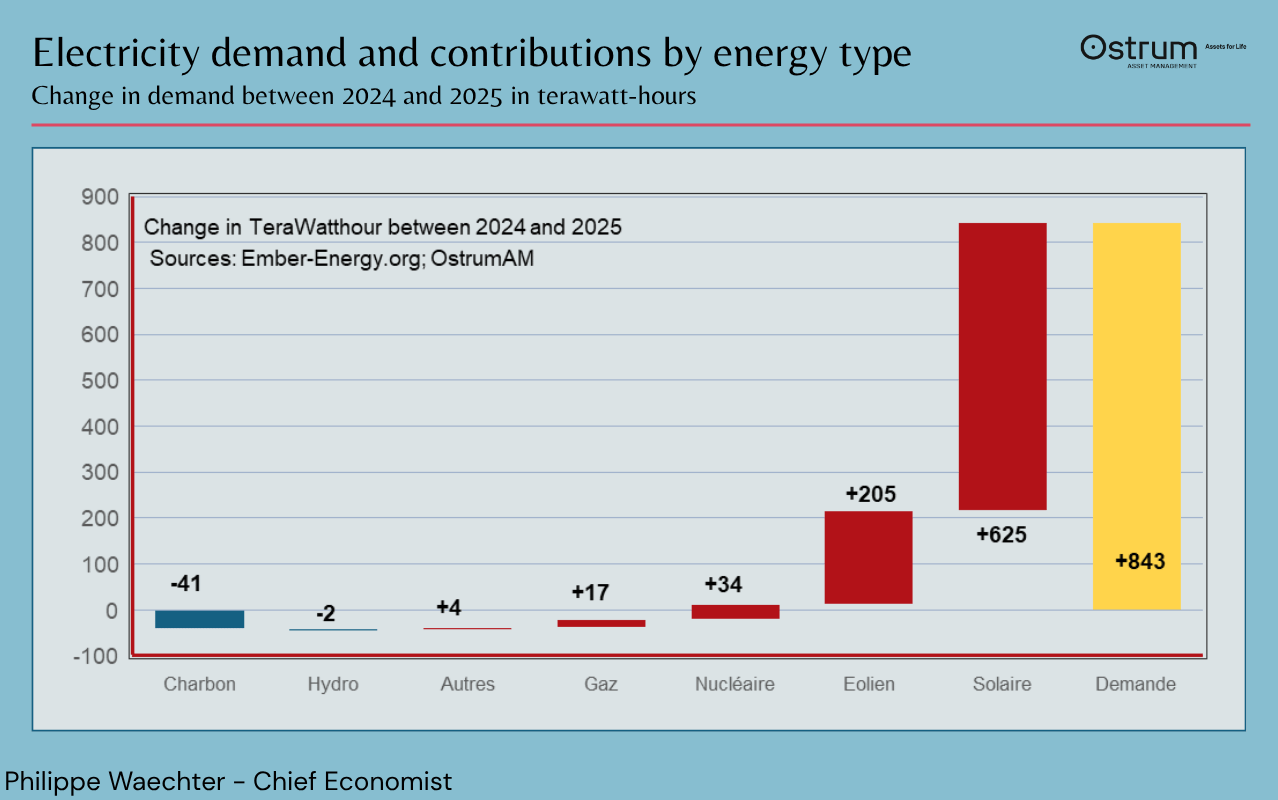
Another first: the increase in electricity demand in 2025 was entirely met by renewables.
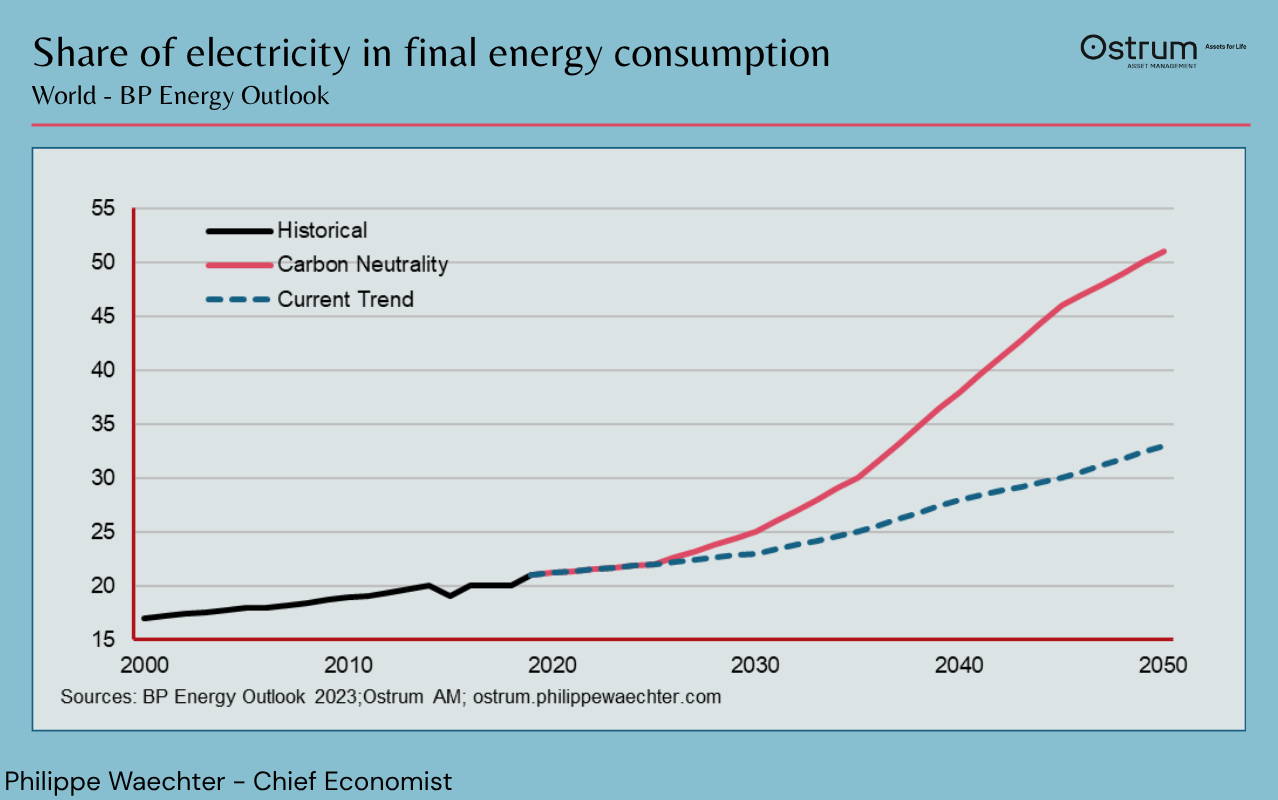
But electricity only accounts for about 20% of final energy consumption. A little less than 25% in Europe and the United States, nearly 30% in China, and much less elsewhere.

Celebrating the decarbonization of electricity is only addressing one-fifth of the problem.
The data published on June 30 by the Energy Institute is unequivocal: fossil fuels—oil, gas, and coal—still accounted for 86.2% of global primary energy consumption in 2025. Everything else—nuclear, solar, wind, hydroelectric, and biomass—represents barely 15%. Transportation, industry, construction: wherever electricity doesn’t reach, fossil fuels reign supreme. And there, decarbonization will be a long battle.
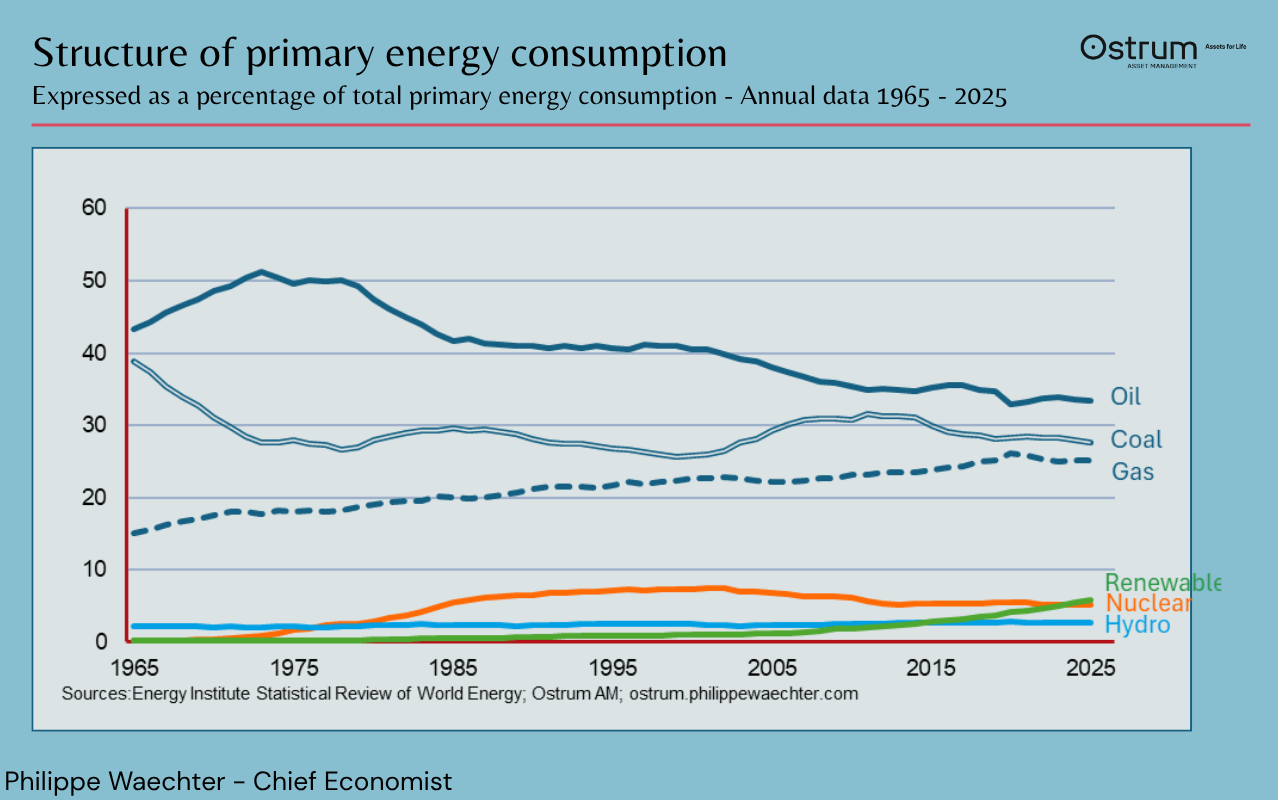
The historical perspective is stark. In 1965, when these statistics began, fossil fuels accounted for 97.4% of the energy market. Sixty years of effort to gain eleven percentage points. At this rate, fossil fuels are here to stay—unless we accept a scenario of sustained energy degrowth.

Carbon neutrality requires electricity to cover 50% of final energy consumption. This means more than doubling the share of electricity, while simultaneously decarbonizing it entirely. Recent investments are a step in the right direction, but they fall far short of what’s needed, and 2050 is just around the corner.

And the equation becomes more complicated: the electrification of uses requires massive investments, which the demand from data centers further inflates — in the United States, it is already driving up electricity consumption, and this is just the beginning.

Our conviction: the energy market in all its forms will remain the key to development and growth in the years to come.

Philippe Waechter is Ostrum AM chief economist in Paris
Subscribe to the newsletter

All the news from Philippe Waechter’s blog in your mailbox


Loading

Le magazine d’experts d’Ostrum

ABOUT OSTRUM AM
  • About us
  • Media room
  • Our publications
  • Cookie Policy (EU)
FOLLOW ME ON
EXTERNAL LINKS
  • Economists
  • Think tank
  • Central banks
  • Blog roll
©Ostrum AM 2026
An affiliate of : Plan de travail 2

Input your search keywords and press Enter.

Manage Cookie Consent

To provide the best experiences, we use technologies such as cookies to store and/or access information on devices. Consenting to these technologies will allow us to process data such as browsing behavior or unique IDs on this site. Not consenting or withdrawing consent may negatively affect certain features and functions.

Functional Always active
The technical storage or access is strictly necessary for the legitimate purpose of enabling the use of a specific service explicitly requested by the subscriber or user, or for the sole purpose of carrying out the transmission of a communication over an electronic communications network.
Preferences
The technical storage or access is necessary for the legitimate purpose of storing preferences that are not requested by the subscriber or user.
Statistics
The technical storage or access that is used exclusively for statistical purposes. The technical storage or access that is used exclusively for anonymous statistical purposes. Without a subpoena, voluntary compliance on the part of your Internet Service Provider, or additional records from a third party, information stored or retrieved for this purpose alone cannot usually be used to identify you.
Marketing
The technical storage or access is required to create user profiles to send advertising, or to track the user on a website or across several websites for similar marketing purposes.
  • Manage options
  • Manage services
  • Manage {vendor_count} vendors
  • Read more about these purposes
View preferences
  • {title}
  • {title}
  • {title}