

Ostrum
  • News & Chronicles
  • France
  • Euro Area
  • United States
  • International
  • Politics & Society
  • Monetary Policy
  • Media
  • Decoding
  • About Philippe Waechter
Philippe Waechter's blog
  • Insights
  • About us
  • Expertise
  • Our people
  • Media

Philippe Waechter's blog
My french blog
  • News & Chronicles
  • France
  • Euro Area
  • United States
  • International
  • Politics & Society
  • Monetary Policy
  • Media
  • Decoding
  • About Philippe Waechter
  • News & Chronicles
  • Climate
  • France
  • Euro Area
  • United States
  • International
  • Politics & Society
  • Monetary Policy
  • Media
  • Decoding
Philippe Waechter's blog
Prévôté
Previous
  • 2 min

Long-term rates: the end of the old world

  • 26 August 2026
  • Philippe Waechter
  • Fiscal Policy
  • Inflation
  • Interest Rates
Total
0
Shares
0
0
0
Read in pdf Long Term interest rate dynamicsDownload the document

Synthesis

The recent rise in long-term interest rates may no longer be a simple adjustment. The conflict in Iran, oil prices hovering around $90, and persistent US inflation have acted as triggers. But behind these immediate factors lies a deeper transformation: the world that allowed for persistently low rates is disappearing.

The first change: inflation could become structurally higher and more volatile. Since the 1980s, globalization, offshoring, and international value chains had allowed developed economies to import disinflation. Geopolitical fragmentation is gradually reversing this dynamic: reshoring, tensions over raw materials and strategic components, rising energy costs, and a shrinking workforce due to aging are creating more pressure on costs and wages.

The second change: US monetary policy is becoming less predictable. Warsh wants to reduce the Fed’s communication and challenge forward guidance. The goal is to make markets more dependent on their own analysis of the economy. But less information also means a wider range of expectations and potentially more volatility in interest rates.

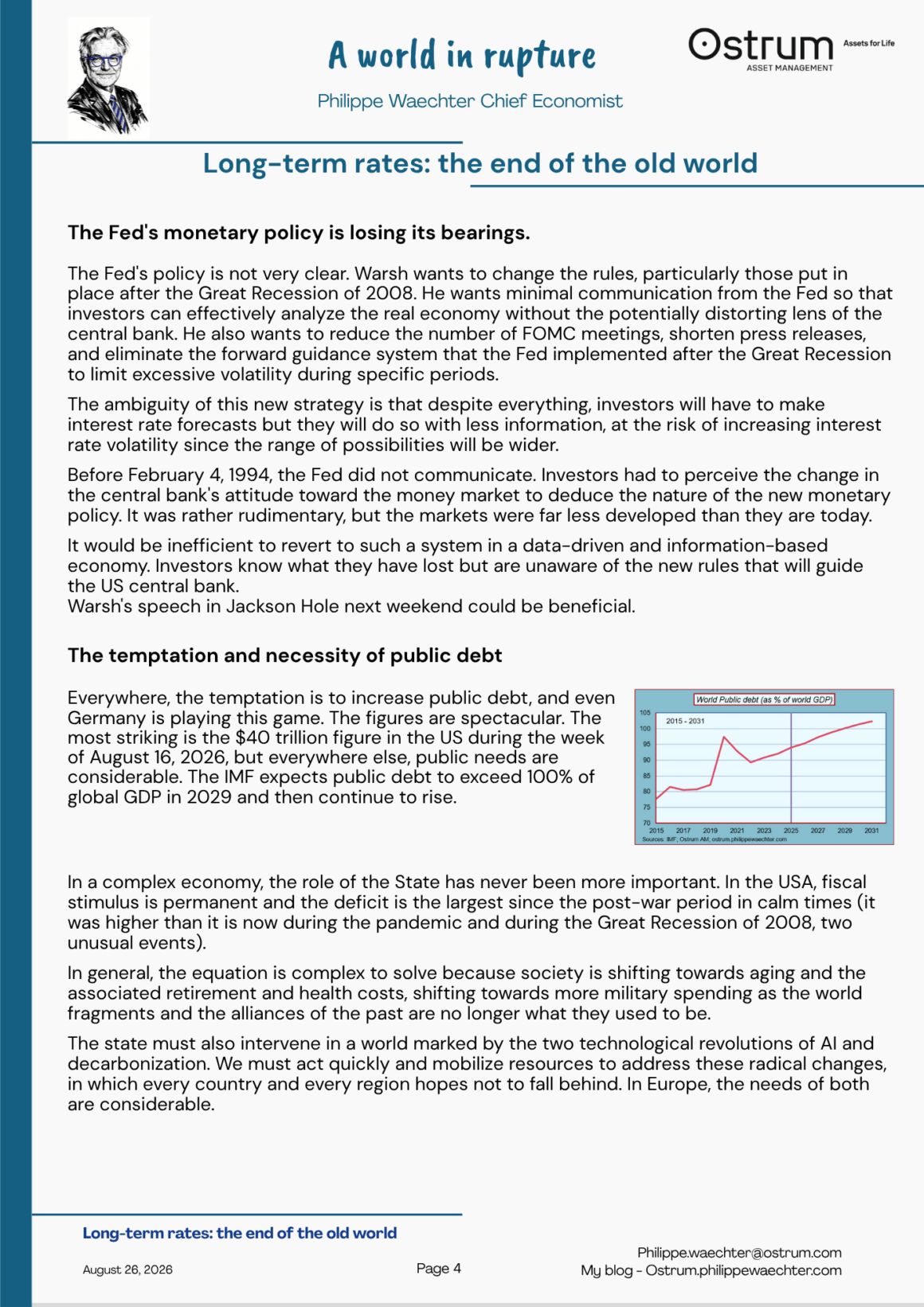
Third disruption: the explosion in public financing needs. US debt has just surpassed $40 trillion, and the IMF expects global public debt to exceed 100% of GDP by 2029. Aging populations, healthcare, defense, AI, decarbonization, and industrial policy are all requiring substantial spending. The supply of public debt will therefore remain structurally abundant.

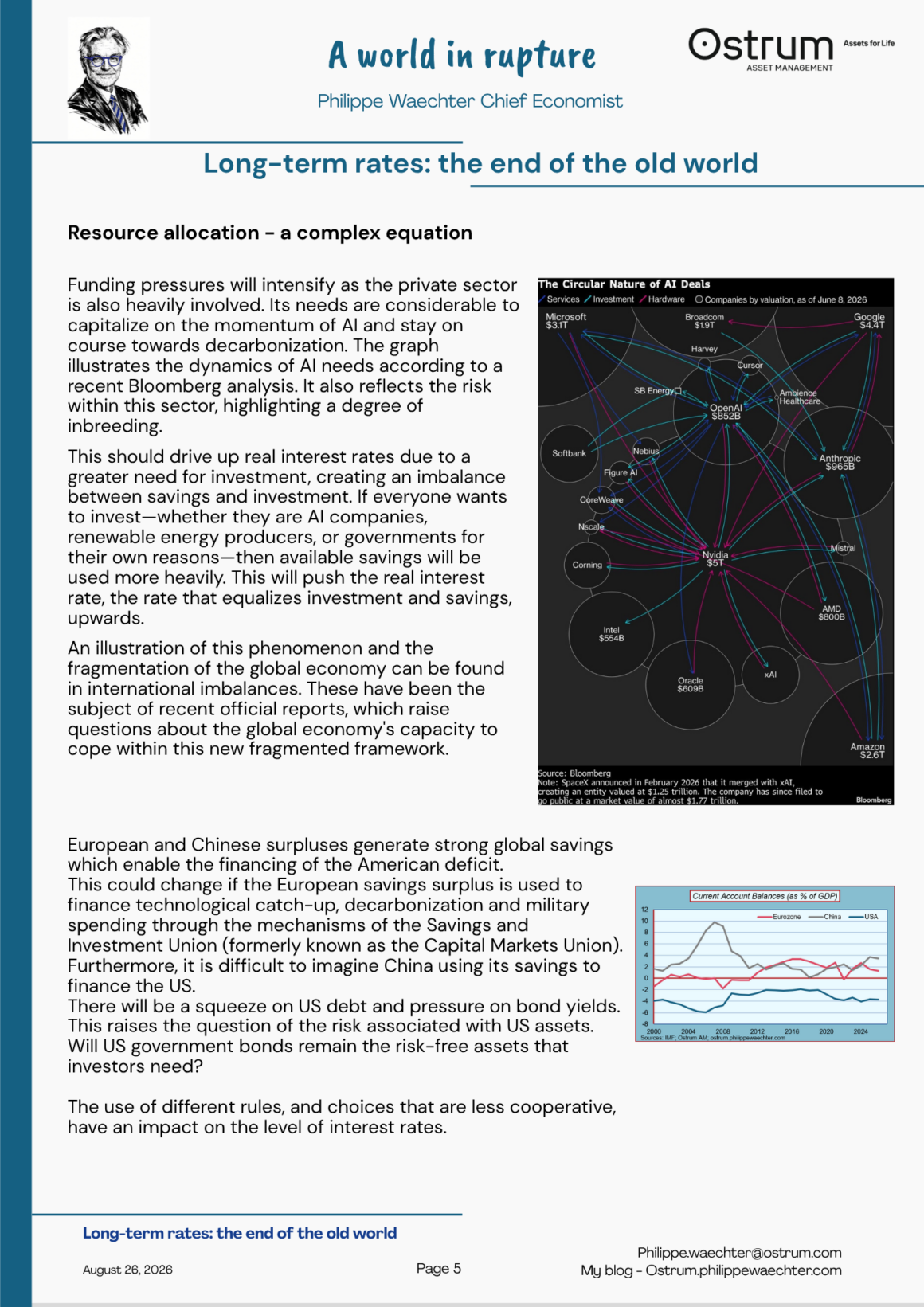
Added to this is growing competition between public and private capital needs. AI, electricity infrastructure, and the climate transition require massive investments. If European savings increasingly finance its own technological catch-up, and if China recycles fewer of its surpluses to the United States, US debt could face less automatic external demand. The result would be further pressure on real interest rates and bond yields.

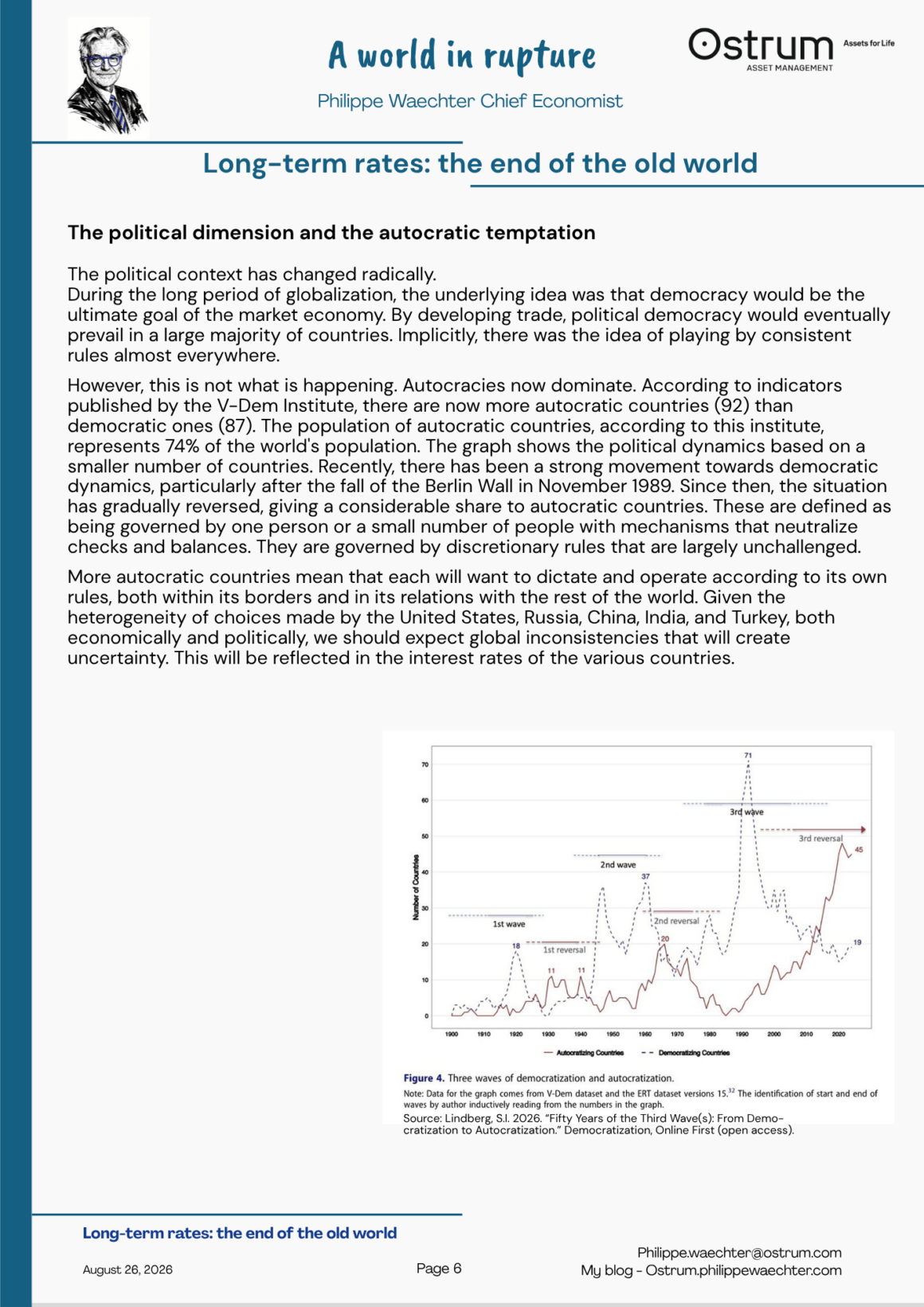
Finally, the change is political and institutional. The world of globalization was based on the idea of ​​a convergence of rules and institutions. This convergence is fading in favor of national strategies, competing industrial policies, and power dynamics. This heterogeneity increases uncertainty and demands a higher premium for long-term capital investment.

This may be the real regime change: long-term interest rates are now rising because the global system is becoming less predictable, less cooperative, and more capital-intensive. Globalization had fostered convergence and lower interest rates; fragmentation could produce the exact opposite.
Related Topics
  • Fiscal Policy
  • Inflation
  • Interest Rates
Subscribe to the newsletter

All the news from Philippe Waechter’s blog in your mailbox


Loading

Le magazine d’experts d’Ostrum

ABOUT OSTRUM AM
  • About us
  • Media room
  • Our publications
  • Cookie Policy (EU)
FOLLOW ME ON
EXTERNAL LINKS
  • Economists
  • Think tank
  • Central banks
  • Blog roll
©Ostrum AM 2026
An affiliate of : Plan de travail 2

Input your search keywords and press Enter.

Manage Cookie Consent

To provide the best experiences, we use technologies such as cookies to store and/or access information on devices. Consenting to these technologies will allow us to process data such as browsing behavior or unique IDs on this site. Not consenting or withdrawing consent may negatively affect certain features and functions.

Functional Always active
The technical storage or access is strictly necessary for the legitimate purpose of enabling the use of a specific service explicitly requested by the subscriber or user, or for the sole purpose of carrying out the transmission of a communication over an electronic communications network.
Preferences
The technical storage or access is necessary for the legitimate purpose of storing preferences that are not requested by the subscriber or user.
Statistics
The technical storage or access that is used exclusively for statistical purposes. The technical storage or access that is used exclusively for anonymous statistical purposes. Without a subpoena, voluntary compliance on the part of your Internet Service Provider, or additional records from a third party, information stored or retrieved for this purpose alone cannot usually be used to identify you.
Marketing
The technical storage or access is required to create user profiles to send advertising, or to track the user on a website or across several websites for similar marketing purposes.
  • Manage options
  • Manage services
  • Manage {vendor_count} vendors
  • Read more about these purposes
View preferences
  • {title}
  • {title}
  • {title}