


Ostrum
  • News & Chronicles
  • France
  • Euro Area
  • United States
  • International
  • Politics & Society
  • Monetary Policy
  • Media
  • Decoding
  • About Philippe Waechter
Philippe Waechter's blog
  • Insights
  • About us
  • Expertise
  • Our people
  • Media

Philippe Waechter's blog
My french blog
  • News & Chronicles
  • France
  • Euro Area
  • United States
  • International
  • Politics & Society
  • Monetary Policy
  • Media
  • Decoding
  • About Philippe Waechter
  • News & Chronicles
  • Climate
  • France
  • Euro Area
  • United States
  • International
  • Politics & Society
  • Monetary Policy
  • Media
  • Decoding
Philippe Waechter's blog
Prévôté
Previous
  • 2 min

The world is sick, since its temperature does not drop

  • 14 January 2026
  • Philippe Waechter
  • Climate Change
  • Paris Agreement
  • temperature
Total
0
Shares
0
0
0

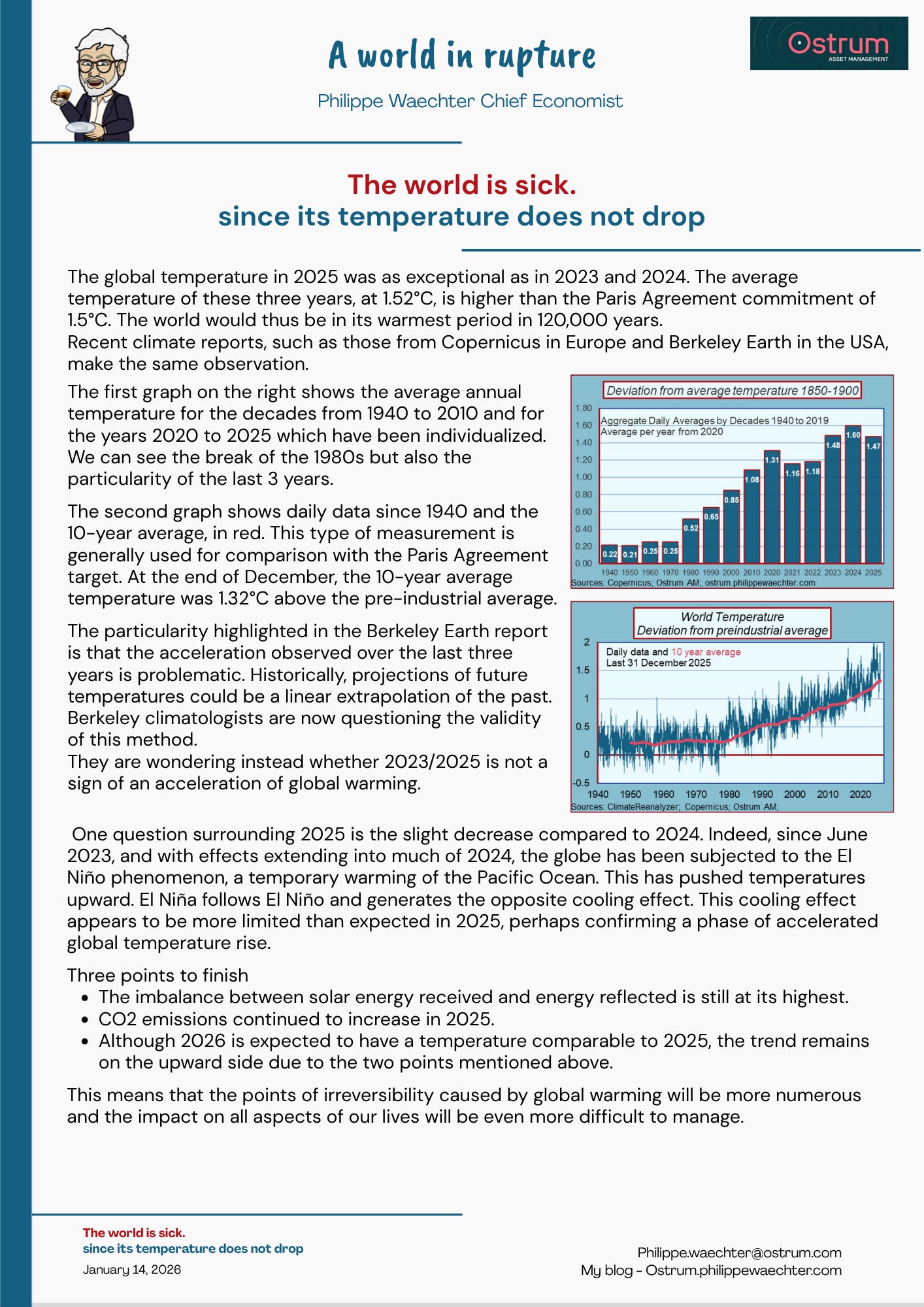
The global temperature in 2025 was as exceptional as in 2023 and 2024. The average temperature of these three years, at 1.52°C, is higher than the Paris Agreement commitment of 1.5°C. The world would thus be in its warmest period in 120,000 years.
Recent climate reports, such as those from Copernicus in Europe and Berkeley Earth in the USA, make the same observation.

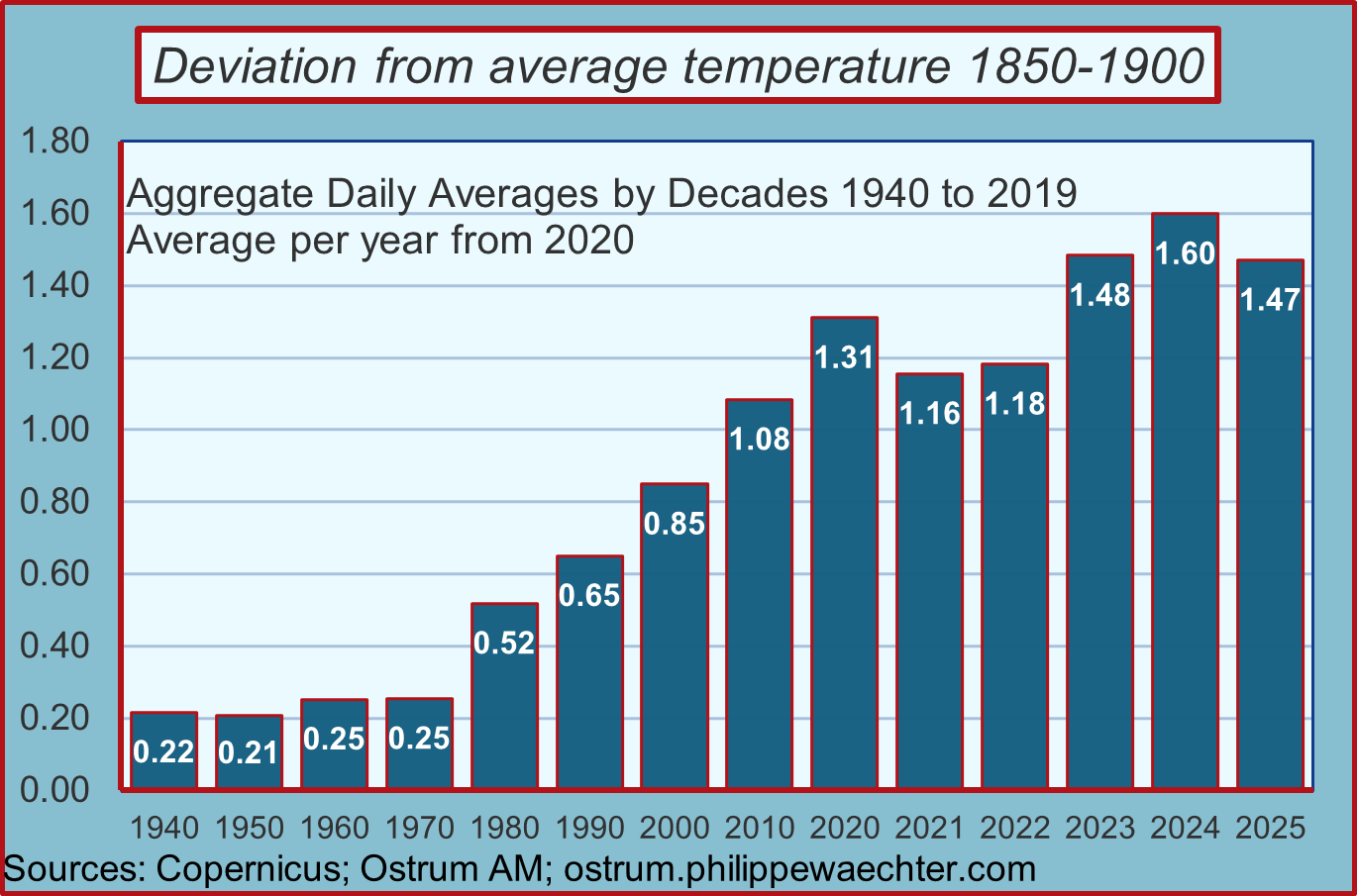
The first graph on the right shows the average annual temperature for the decades from 1940 to 2010 and for the years 2020 to 2025 which have been individualized.
We can see the break of the 1980s but also the particularity of the last 3 years.
The second graph shows daily data since 1940 and the 10-year average, in red. This type of measurement is generally used for comparison with the Paris Agreement target. At the end of December, the 10-year average temperature was 1.32°C above the pre-industrial average.
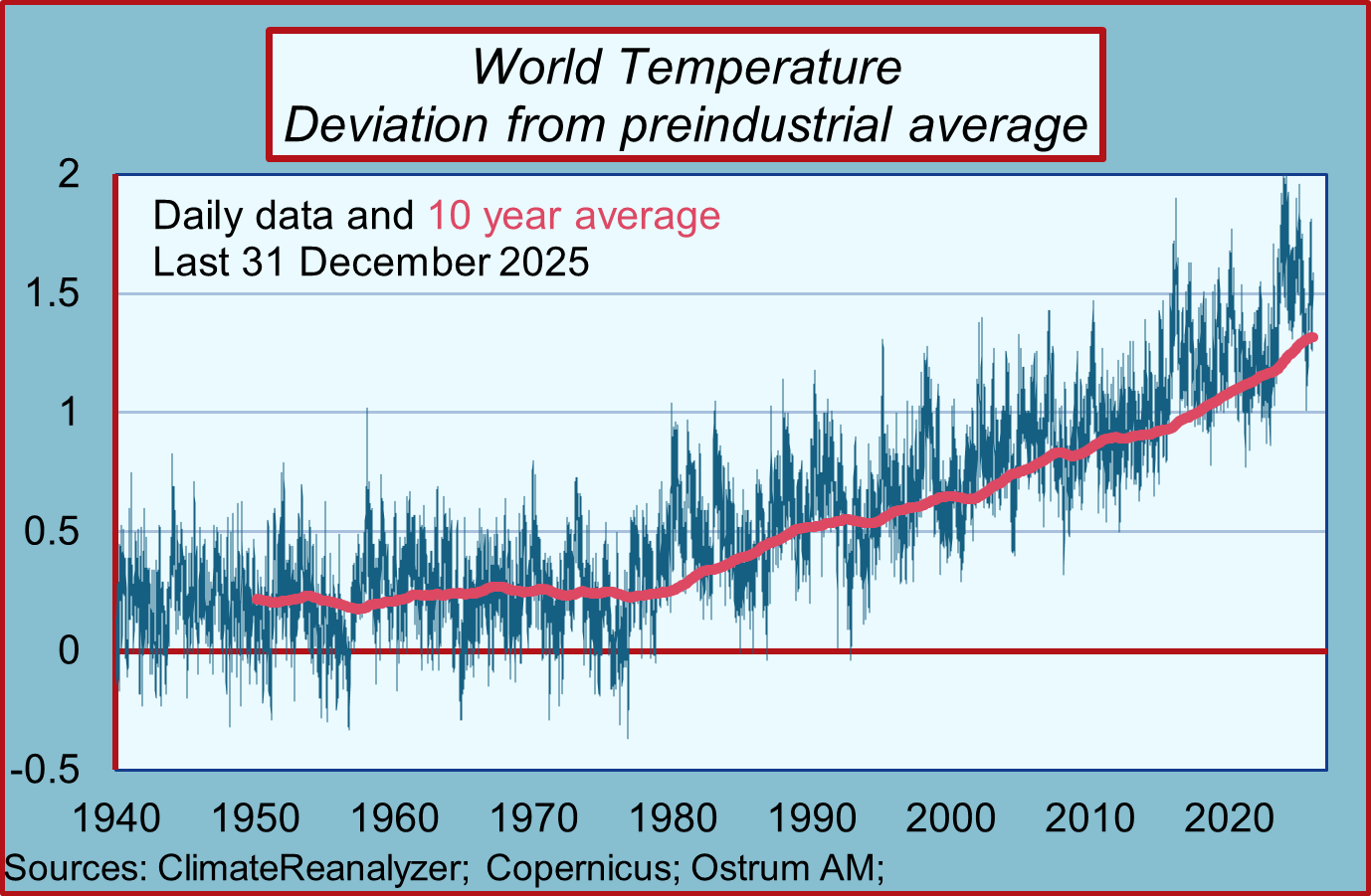
The particularity highlighted in the Berkeley Earth report is that the acceleration observed over the last three years is problematic. Historically, projections of future temperatures could be a linear extrapolation of the past. Berkeley climatologists are now questioning the validity of this method.
They are wondering instead whether 2023/2025 is not a sign of an acceleration of global warming.

One question surrounding 2025 is the slight decrease compared to 2024. Indeed, since June 2023, and with effects extending into much of 2024, the globe has been subjected to the El Niño phenomenon, a temporary warming of the Pacific Ocean. This has pushed temperatures upward. El Niña follows El Niño and generates the opposite cooling effect. This cooling effect appears to be more limited than expected in 2025, perhaps confirming a phase of accelerated global temperature rise.

Share Philippe Waechter’s Economic Posts

Three points to finish
1- The imbalance between solar energy received and energy reflected is still at its highest.
2- CO2 emissions continued to increase in 2025.
3- Although 2026 is expected to have a temperature comparable to 2025, the trend remains on the upward side due to the two points mentioned above.

This means that the points of irreversibility caused by global warming will be more numerous and the impact on all aspects of our lives will be even more difficult to manage.
Related Topics
  • Climate Change
  • Paris Agreement
  • temperature
Subscribe to the newsletter

All the news from Philippe Waechter’s blog in your mailbox


Loading

Le magazine d’experts d’Ostrum

ABOUT OSTRUM AM
  • About us
  • Media room
  • Our publications
  • Cookie Policy (EU)
FOLLOW ME ON
EXTERNAL LINKS
  • Economists
  • Think tank
  • Central banks
  • Blog roll
©Ostrum AM 2026
An affiliate of : Plan de travail 2

Input your search keywords and press Enter.

Manage Cookie Consent
We use cookies to optimize our website and our service.
Functional Always active
The technical storage or access is strictly necessary for the legitimate purpose of enabling the use of a specific service explicitly requested by the subscriber or user, or for the sole purpose of carrying out the transmission of a communication over an electronic communications network.
Preferences
The technical storage or access is necessary for the legitimate purpose of storing preferences that are not requested by the subscriber or user.
Statistics
The technical storage or access that is used exclusively for statistical purposes. The technical storage or access that is used exclusively for anonymous statistical purposes. Without a subpoena, voluntary compliance on the part of your Internet Service Provider, or additional records from a third party, information stored or retrieved for this purpose alone cannot usually be used to identify you.
Marketing
The technical storage or access is required to create user profiles to send advertising, or to track the user on a website or across several websites for similar marketing purposes.
Manage options Manage services Manage {vendor_count} vendors Read more about these purposes
View preferences
{title} {title} {title}