

Donald Trump’s main campaign promise is the relocation of manufacturing to the United States. During the long period of globalization, industrial jobs have shifted to Asia, and China in particular, leaving many regions devastated by rising unemployment. This phenomenon has been argued to be all the more damaging because the incomes associated with low-skilled or unskilled jobs have barely increased, unlike the incomes of Chinese workers.
There was a kind of double penalty for American workers, primarily benefiting China. Trump, and later Biden, sought to reverse this trend and revive manufacturing employment, both to produce locally, restore jobs in the hardest-hit regions, and reduce US dependence. This ambitious program is not reflected in the figures.
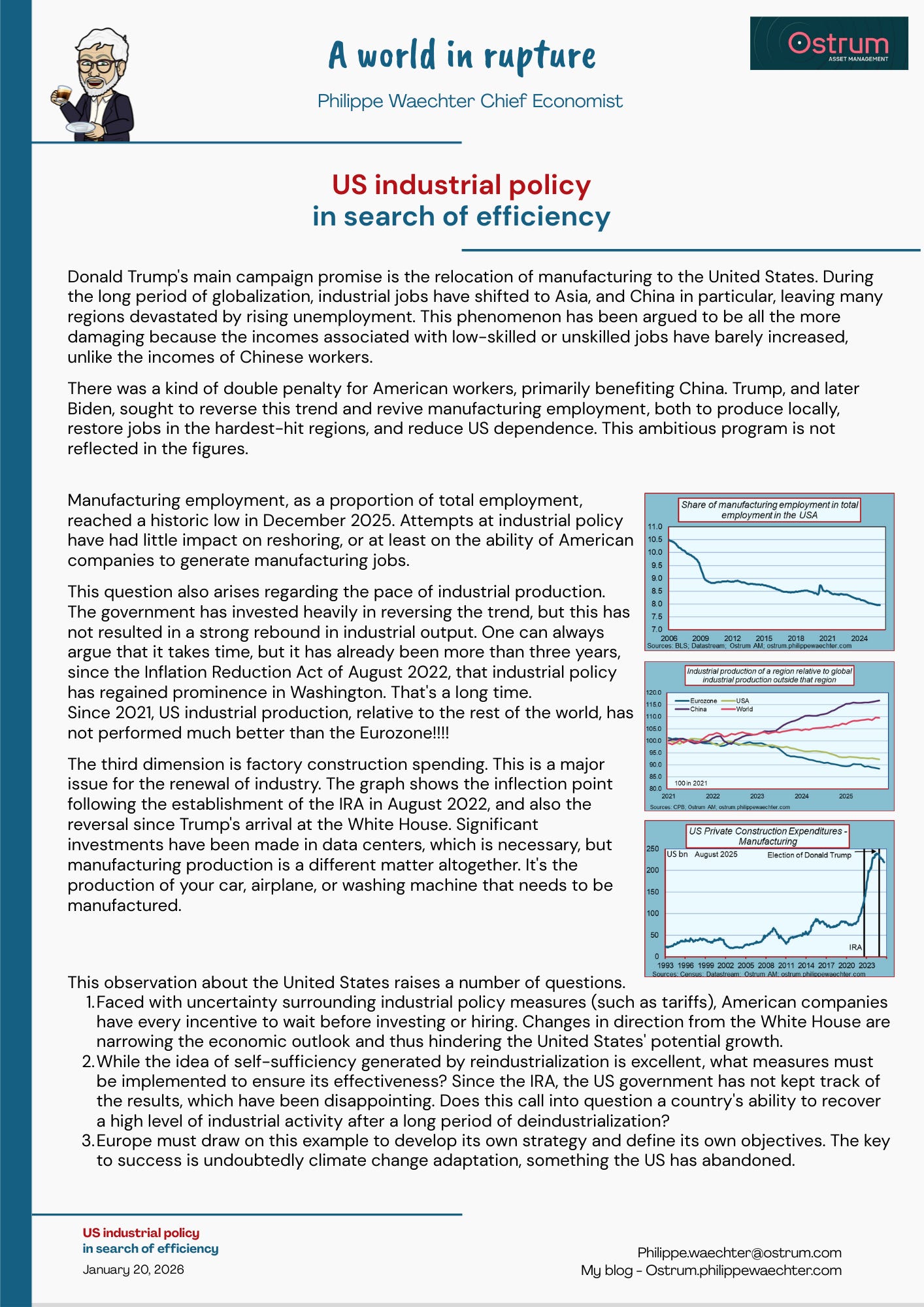
- Manufacturing employment, as a proportion of total employment, reached a historic low in December 2025. Attempts at industrial policy have had little impact on reshoring, or at least on the ability of American companies to generate manufacturing jobs.

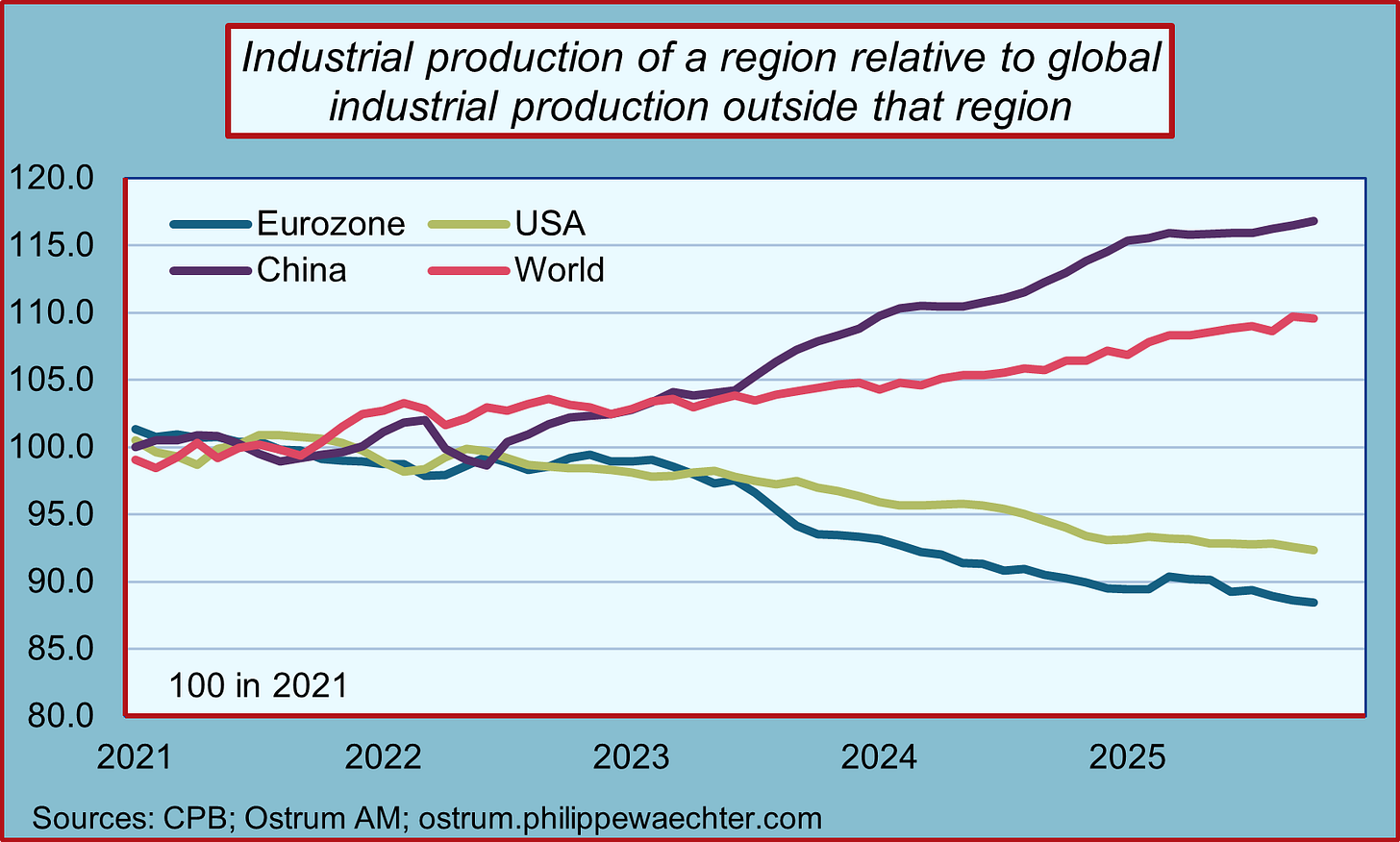
- This question also arises regarding the pace of industrial production. The government has invested heavily in reversing the trend, but this has not resulted in a strong rebound in industrial output. One can always argue that it takes time, but it has already been more than three years, since the Inflation Reduction Act of August 2022, that industrial policy has regained prominence in Washington. That’s a long time.
Since 2021, US industrial production, relative to the rest of the world, has not performed much better than the Eurozone!!!!
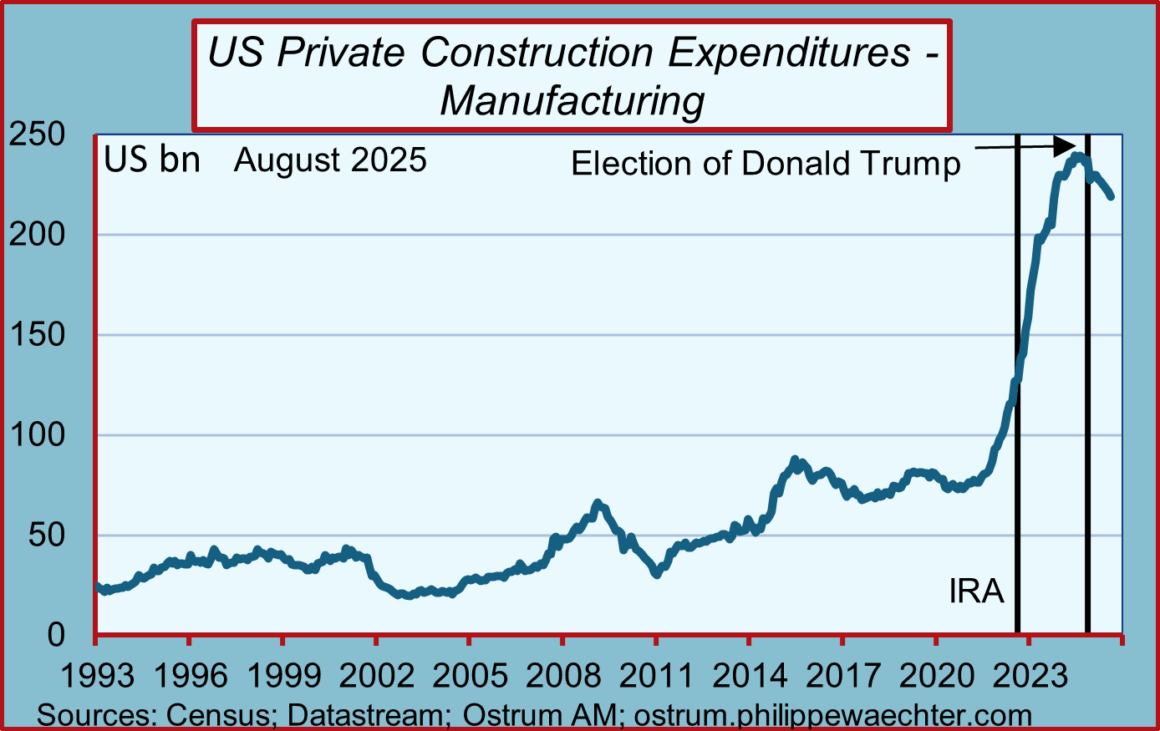
- The third dimension is factory construction spending. This is a major issue for the renewal of industry. The graph shows the inflection point following the establishment of the IRA in August 2022, and also the reversal since Trump’s arrival at the White House. Significant investments have been made in data centers, which is necessary, but manufacturing production is a different matter altogether. It’s the production of your car, airplane, or washing machine that needs to be manufactured
This observation about the United States raises a number of questions.
- Faced with uncertainty surrounding industrial policy measures (such as tariffs), American companies have every incentive to wait before investing or hiring. Changes in direction from the White House are narrowing the economic outlook and thus hindering the United States’ potential growth.
- While the idea of self-sufficiency generated by reindustrialization is excellent, what measures must be implemented to ensure its effectiveness? Since the IRA, the US government has not kept track of the results, which have been disappointing. Does this call into question a country’s ability to recover a high level of industrial activity after a long period of deindustrialization?
- Europe must draw on this example to develop its own strategy and define its own objectives. The key to success is undoubtedly climate change adaptation, something the US has abandoned.